Why an Annual Roof Inspection Saves Thousands in Leak Repairs
import { CTA } from "@/components/blog/cta"; import { InternalLink } from "@/components/blog/internal-link"; import { FAQSection } from "@/components/blog/faq-section";
Let's talk about numbers.
A professional roof inspection in the Tampa Bay area typically costs $150–$350. Many reputable companies, including Shield Roof Pro, offer them free as part of a customer relationship.
The average cost of an emergency roof leak repair in Florida — after water has damaged decking, insulation, drywall, and possibly personal property — runs $3,000–$8,000.
The average cost of a full roof replacement that could have been planned and budgeted instead of emergency-forced: $8,000–$18,000 depending on size and materials.
The average cost of mold remediation after a roof leak went undetected for months: $2,000–$10,000.
Do the math. A single annual inspection that catches one problem before it becomes a leak pays for itself many times over. And most homeowners we meet have never had their roof professionally inspected — not once, not ever, not in the 15 years they've owned their home.
At Shield Roof Pro, serving Spring Hill, Hudson, New Port Richey, Holiday, Port Richey, Elfers, and Clearwater Beach, we see the consequences of this gap every single day. This article explains why annual inspections matter, what the data says about early detection, what a professional inspector actually looks for, and why this one appointment is the highest-return home maintenance investment you can make.
The Data on Early Detection and Cost Savings
The relationship between early problem detection and repair cost is not linear. It's exponential.
A roofing problem caught in Stage 1 — early material degradation, before any water intrusion — typically costs $100–$500 to fix. A resealed pipe boot. A re-nailed shingle. A replaced section of counter flashing. Simple, targeted, inexpensive.
The same problem caught in Stage 3 — after water has entered the structure, damaged the deck, soaked insulation, and stained drywall — costs $3,000–$8,000 to fix. And that's just the roof repair. It doesn't include interior restoration, which adds another $2,000–$5,000.
The same problem caught in Stage 5 — after months of undetected moisture has led to mold growth, structural softening, and potential health concerns — costs $10,000–$30,000 or more. At this point, you're not fixing a roof. You're remediating a building.
What the Research Shows
A study by the National Association of Home Builders (NAHB) found that regular roof inspections extend the average service life of an asphalt shingle roof by 20–30%. In Florida terms, that's the difference between a roof lasting 15 years and one lasting 19–20 years. On an $12,000 roof, that's $2,400–$3,600 in deferred replacement cost — just from annual inspections.
The Insurance Institute for Business & Home Safety (IBHS) found that homes with documented annual roof inspections filed 42% fewer water damage insurance claims over a 10-year period compared to similar homes without inspection histories. Fewer claims means lower out-of-pocket costs and, in many cases, lower insurance premiums.
Data from our own inspection records at Shield Roof Pro tells a similar story. Of the emergency leak repairs we performed in 2025: 73% of the homes had never had a professional roof inspection 19% had an inspection more than two years prior Only 8% had an inspection within the previous 12 months
In other words, the homeowners who were getting their roofs inspected annually were almost never calling us for emergency leak repairs. The inspections caught the problems first.
What a Professional Roof Inspector Actually Looks For
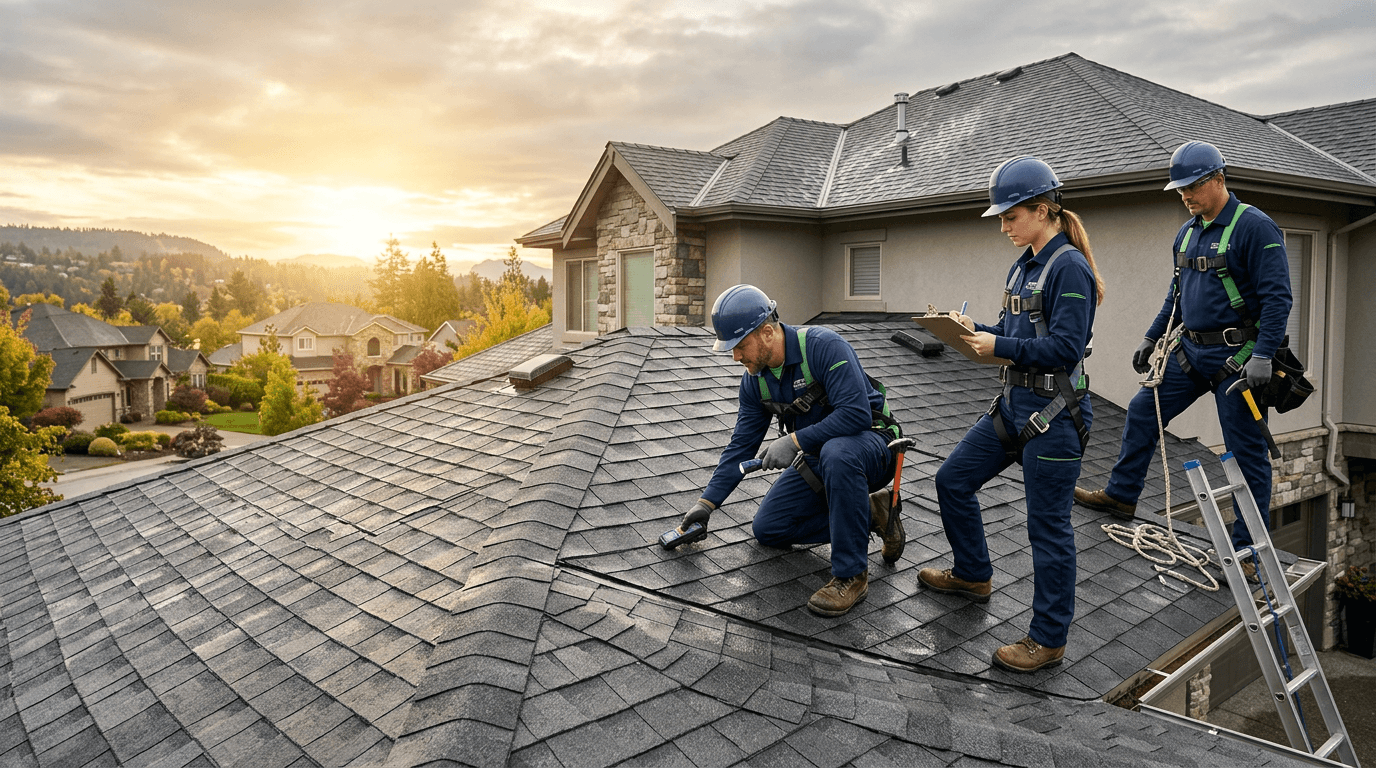
A thorough professional roof inspection is nothing like a homeowner's visual check from the driveway. It's a systematic examination of every component of your roofing system, from both the exterior and the interior.
Exterior Inspection
Shingle or tile condition assessment: The inspector evaluates not just for missing pieces but for early-stage degradation — granule loss patterns, curling edges, cracked sealant strips, blistering, and color inconsistency that indicates uneven UV exposure or manufacturing variation. On tile roofs, they check for hairline cracks that aren't visible from the ground but will become full fractures within a season.
Fastener integrity: Nails and screws that secure your roofing material can back out over time due to thermal cycling. A popped nail head lifts the shingle above it, breaking the seal and creating a wind entry point. Insors check for nail pop patterns across the entire roof surface.
Flashing examination: As we detailed in our dedicated flashing article, flashing is the #1 source of roof leaks. A professional inspector examines every piece of flashing — pipe boots, chimney flashing, step flashing, valley flashing, and drip edge — both from the roof surface and, critically, from inside the attic looking up.
Valley performance analysis: Valleys carry the most water on your roof. Inspectors check for proper shingle clearance, channel condition, debris accumulation patterns, and any signs of underlayment exposure that indicates the valley is approaching failure.
Ridge and hip assessment: Ridge caps and hip tiles experience the highest wind forces. Inspectors verify proper attachment, seal integrity, and any signs of lifting or separation.
Gutter and drainage evaluation: While gutters aren't the roof surface, their condition directly affects roof edge health. Inspectors check for granule accumulation (which indicates shingle aging), proper slope and drainage, and any evidence of water backing up behind the gutter system.
Skylight and penetration seals: Every object that penetrates your roof — skylights, vent pipes, exhaust vents, satellite dish mounts, solar panel attachments — is a potential leak point. Each one gets a hands-on seal integrity check.
Interior and Attic Inspection
Deck condition from below: The inspector enters your attic and examines the underside of the roof deck. This is where early water damage shows up first — as dark staining, soft spots, or delamination — often weeks or months before any visible sign appears on the interior ceiling.
Ventilation assessment: Proper attic ventilation is critical to roof health. Inspectors measure the ratio of intake (soffit) ventilation to exhaust (ridge or gable) ventilation, check for blocked or crushed baffles, and look for condensation on the underside of the deck — a sign of inadequate ventilation.
Insulation condition: Wet or compressed insulation indicates past or ongoing water intrusion. Inspectors check for damp spots, compressed areas, and insulation that has shifted away from the deck, which can indicate previous water flow paths.
Light penetration test: On a sunny day, the inspector looks for any points where daylight is visible through the roof system from inside the attic. If light can get in, water can get in.
Documentation and Reporting
A quality inspection concludes with a written report that includes:
Photographs of every area of concern A roof condition rating (typically on a 1–10 scale) Prioritized repair recommendations with cost estimates Remaining useful life estimate for the current roof Any items that need immediate attention vs. monitoring vs. future planning
This report becomes your roof's health record. It's the baseline against which future inspections are compared, and it's the documentation you need for insurance purposes, home sale transactions, and budget planning.
The Timing Question: Why Annual?
Some homeowners ask: "Why not every two years? Or just after a bad storm?"
Annual inspections are the sweet spot for several reasons:
Material degradation timelines: Most common roofing problems develop on a 12–24 month cycle. A pipe boot starts cracking in spring, is fully split by the following winter, and causes a leak the next rainy season. An annual inspection catches it at the cracking stage. A biennial inspection catches it at the leak stage.
Insurance and warranty requirements: Many roofing manufacturers require annual professional inspections to maintain warranty coverage. Similarly, some Florida insurance carriers offer premium discounts for documented annual inspections. If you're on a two-year cycle, you may be voiding protections you don't realize you have.
Budget predictability: An annual inspection gives you a 12-month lookahead on roof needs. If your inspector says your roof has 3–5 years of useful life remaining, you can start saving and planning. If you wait until a leak forces the issue, you're making financial decisions under pressure with limited options.
Storm documentation: In Florida, having a pre-storm inspection report on file strengthens your insurance position enormously. If a storm causes damage, you can prove the roof was in good condition beforehand, making the claim cleaner and faster to resolve.
What Homeowners Can Do Between Professional Inspections
Annual professional inspections are non-negotiable for roof health. Between those inspections, homeowners can and should perform basic maintenance:
Seasonal ground-level visual checks using binoculars (as outlined in our Florida maintenance checklist) Interior ceiling checks after major rain events — look for new stains, bubbling paint, or musty odors Attic spot checks a few times per year — look for new dark spots on the deck or damp insulation Gutter monitoring for granule accumulation, which signals shingle aging Photo documentation of any changes you notice, to share with your inspector at the next visit
These homeowner checks complement — but never replace — the annual professional inspection. The difference is like changing your car's oil yourself vs. bringing it to a mechanic for a full diagnostic. Both matter. Neither substitutes for the other.
The ROI Calculation, Plainly Stated
Let's put numbers on the value proposition:
Cost of annual inspections over 20 years: $0–$7,000 (if paid at $350/inspection; $0 if your roofer provides them free)
Average cost of emergency leak repair avoided: $3,000–$8,000 per incident
Average number of leak incidents prevented over 20 years through early detection: 2–4 incidents based on industry data
Average cost of premature roof replacement avoided by extending lifespan 20–30%: $2,400–$5,400
Total estimated savings over 20 years: $8,400–$37,400
Net return on a $0–$7,000 investment: 120% to 5,300%
There is almost no home maintenance activity with this return profile. Not HVAC servicing, not gutter cleaning, not pressure washing, not painting. An annual roof inspection is, by the numbers, the single highest-ROI maintenance task a homeowner can perform.
Schedule Your Inspection Before the Next Storm Season
The best time to schedule your annual roof inspection is right now — not after you see a water stain on your ceiling, not after a neighbor gets hit with storm damage, not when you're trying to sell your home and the buyer's inspector flags three urgent repairs.
At Shield Roof Pro, we provide comprehensive annual roof inspections across Spring Hill, Hudson, New Port Richey, Holiday, Port Richey, Elfers, and Clearwater Beach. Every inspection includes exterior and interior examination, photographic documentation, a written condition report, prioritized repair recommendations, and remaining life estimates.
Your roof protects everything you own. An annual inspection is the cheapest, most effective way to make sure it keeps doing its job.
<CTA phone="727-555-ROOF" text="Schedule your annual roof inspection today. It's the smartest money you'll spend on your home all year." servicesArea="Serving Spring Hill, Hudson, New Port Richey, Holiday, Port Richey, Elfers, and Clearwater Beach, Florida" />
Related reading: Florida Roof Maintenance Checklist: Prevent Leaks Before They Start Roof Flashing Repair: The Number 1 Cause of Leaks Most Roofers Miss Hurricane Season Roof Prep: Protect Your Home Before June
<FAQSection questions={[ { question: "How much does a professional roof inspection cost in Florida?", answer: "A professional roof inspection in the Tampa Bay area typically costs $150–$350, depending on roof size, pitch, and complexity. Many reputable roofing companies, including Shield Roof Pro, offer free inspections as part of building a customer relationship. The inspection should include both exterior and interior (attic) examination, photographic documentation, and a written report." }, { question: "How long does a professional roof inspection take?", answer: "A thorough professional roof inspection takes 45 minutes to 2 hours, depending on roof size, complexity, number of penetrations, and attic accessibility. A simple single-story home with a straightforward roof may take 45 minutes. A larger home with multiple roof planes, chimneys, skylights, and a complex attic may take 2 hours or more. Be wary of inspections completed in under 30 minutes." }, { question: "Can a roof inspection really prevent leaks, or does it just find existing ones?", answer: "A quality roof inspection does both. It identifies active problems causing current leaks, but more importantly, it identifies pre-leak conditions — early material degradation, weakened seals, loose fasteners, and developing flashing failures — that will cause leaks within 6–24 months if not addressed. Catching these pre-leak conditions is where the majority of cost savings comes from." }, { question: "Do I need a roof inspection if my roof is relatively new?", answer: "Yes. Even new roofs can have installation defects that don't cause immediate problems but will lead to premature failure. Improperly sealed pipe boots, insufficient nail patterns, misaligned flashing, and inadequate ventilation are installation issues that may not cause a leak for 2–5 years but are easily identified and corrected during an early inspection. Starting annual inspections from year one maximizes your roof's lifespan." }, { question: "Will my insurance company require a roof inspection?", answer: "Some Florida insurance carriers require a roof inspection for homes with roofs over 10 years old, for policy renewals, or after a certain number of claims. Even when not required, many insurers offer premium discounts for documented annual inspections. Additionally, having inspection reports on file strengthens your position when filing a storm damage claim, as it establishes the roof's pre-storm condition." } ]} />
Need professional roofing help?
Residential Roofing Contractors Pros serves the Tampa Bay area with 18+ years of experience. Request a free estimate through our contact form.
Request Free Estimate